
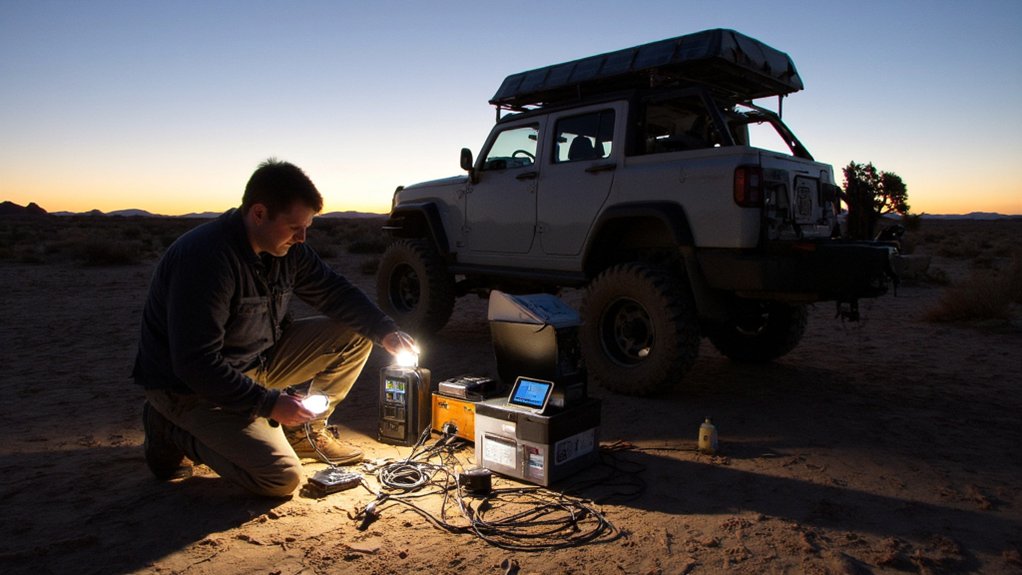
I calculate my overlanding power needs by first listing every device I’ll use, then converting each one’s watts or amps to daily amp-hours by dividing watts by 12V and multiplying by usage hours. I sum these figures, add a 20% safety buffer, and multiply by the days between recharges. Then I apply depth-of-discharge limits—50% for AGM, 80% for lithium—to size my battery bank. I match solar panels to daily consumption using real-world losses, then refine everything after field testing to guarantee the system handles actual demands.
List Every Device in Your Overlanding Power System
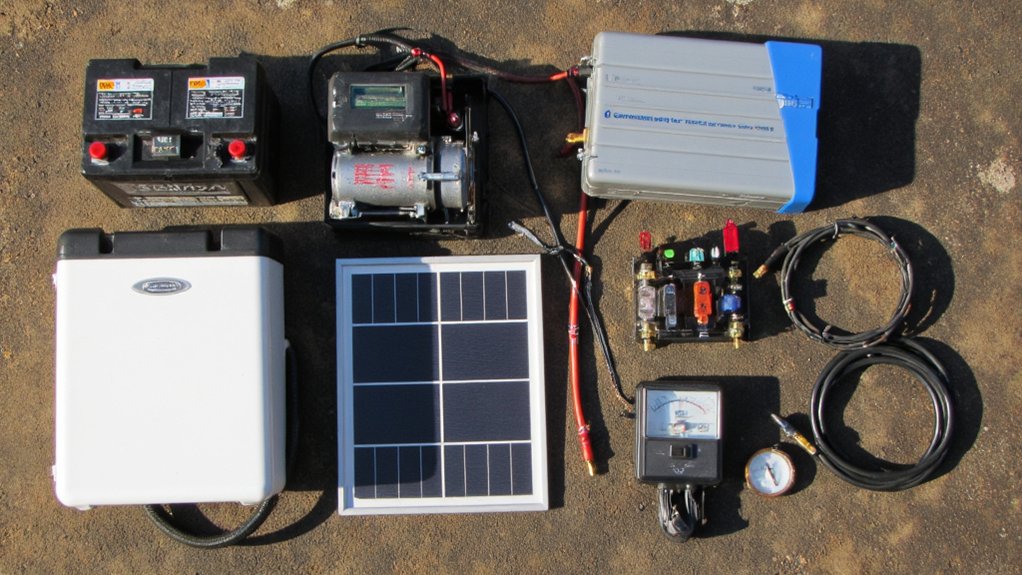
Grab a notebook and start documenting every single electronic device you plan to bring on your overlanding adventure.
I’m talking about everything: phones, laptops, cameras, drones, fridges, lights, fans, and communication gear.
Your device inventory forms the foundation of accurate power planning.
Don’t forget chargers and adapters—they draw power too.
Once you’ve listed everything, sketch out your power topology showing how devices connect to your system.
This visual map reveals which items run simultaneously versus independently.
Understanding these relationships prevents underestimating your actual power requirements.
Pay special attention to your watt-hour consumption for fridges and lighting since these typically represent the largest continuous draws in an overlanding power system.
A thorough inventory eliminates guesswork and guarantees you’ll have sufficient energy throughout your journey.
Convert Watts and Amps to Daily Amp-Hours
Once you’ve cataloged every device, you’ll need to translate their power specifications into a common unit: amp-hours (Ah).
I use this formula: divide watts by your system voltage (typically 12V) to get amps, then multiply by daily usage hours.
For example, a 60W fridge running 8 hours equals 40Ah daily (60÷12×8=40).
I always add 20% for voltage ripple and cable loss—inefficiencies that reduce actual power delivery.
If a device lists only amps, simply multiply by usage hours.
This standardization lets you calculate your total daily power consumption accurately.
Your charge controller must also be sized to match your total amp-hour consumption to ensure your battery bank recharges properly between use cycles.
Calculate Your Total Daily Power Consumption
After converting each device’s consumption to amp-hours, I add them all together to determine my baseline daily power needs.
This total becomes my critical planning figure.
However, I don’t stop there.
I factor in efficiency losses from battery chemistry—lithium batteries offer 95-99% efficiency while lead-acid only provides 80-85%.
I also account for thermal management considerations, as extreme temperatures reduce usable capacity.
Cold weather particularly impacts lithium systems, while heat degrades lead-acid performance.
When selecting a portable power station, I consider whether LiFePO4 thermal safety characteristics better suit my operating environment compared to standard lithium-ion chemistries.
I multiply my baseline by 1.2 to create a safety buffer, ensuring I won’t run short during unexpected circumstances or increased usage days.
Decide How Long You Need Between Recharges
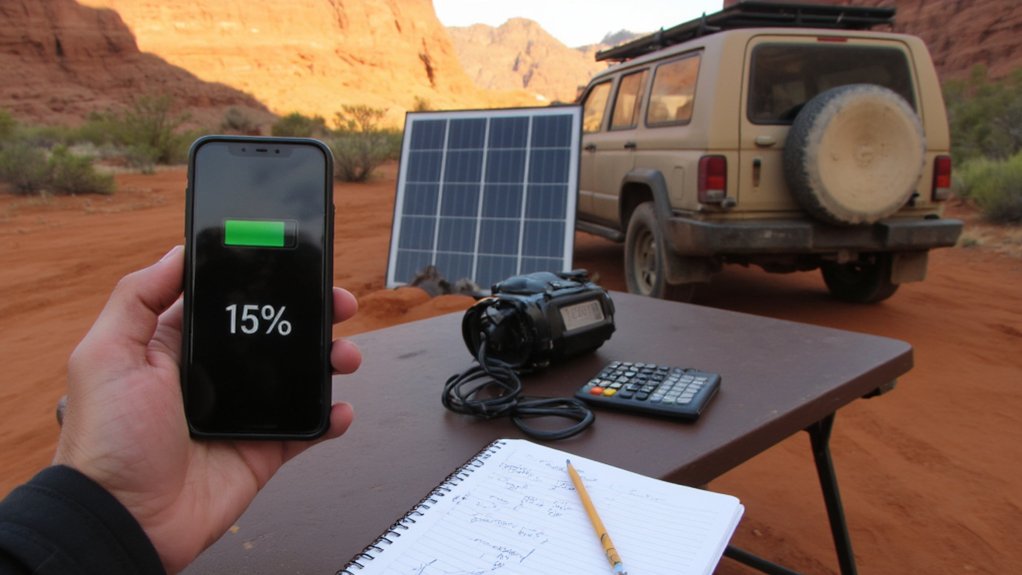
Before selecting battery capacity, I determine my typical recharge interval based on my travel style and available charging methods.
My recharge cadence depends on whether I’m driving daily, which allows alternator charging, or camping stationary for extended periods.
I analyze my usage patterns honestly—do I move camp every two days or stay put for a week?
This reveals whether I need one day’s power reserve or five.
If I’ve solar panels, I calculate realistic daily solar input.
If relying solely on vehicle charging, I determine minimum driving time needed.
These factors establish my required battery capacity baseline.
Multiply Daily Use by Days to Get Total Amp-Hours
I calculate my total battery capacity by multiplying my daily amp-hour consumption by the number of days between recharges.
If I use 50 amp-hours daily and expect three days between charging opportunities, I need 150 amp-hours minimum.
I always add a 20-30% buffer for seasonal variability—shorter winter days reduce solar charging efficiency.
I’m vigilant about unit inconsistency when converting watt-hours to amp-hours; dividing watt-hours by system voltage (12V) gives me accurate amp-hours.
This calculation determines my battery bank size, ensuring I won’t run out of power during extended backcountry stays.
Just as GPS watches with extended battery life ratings help outdoor enthusiasts plan multi-day excursions, proper power calculations prevent unexpected shutdowns in remote locations.
Factor in Depth of Discharge: 50% for AGM, 80% for Lithium
Understanding battery chemistry transforms how I calculate usable capacity.
I can’t drain AGM batteries below 50% without damaging them, so I double my amp-hour requirements.
AGM caveats include reduced lifespan if I discharge too deeply.
Lithium batteries handle 80% depth of discharge, meaning I need only 25% more capacity than calculated.
Lithium quirks involve higher upfront costs but longer cycle life.
For example, if I need 100Ah daily for three days, that’s 300Ah total.
With AGM, I’d need 600Ah of battery capacity.
With lithium, I’d need 375Ah.
This difference impacts weight and budget substantially.
Add a 20-30% Buffer for Temperature and Parasitic Drain
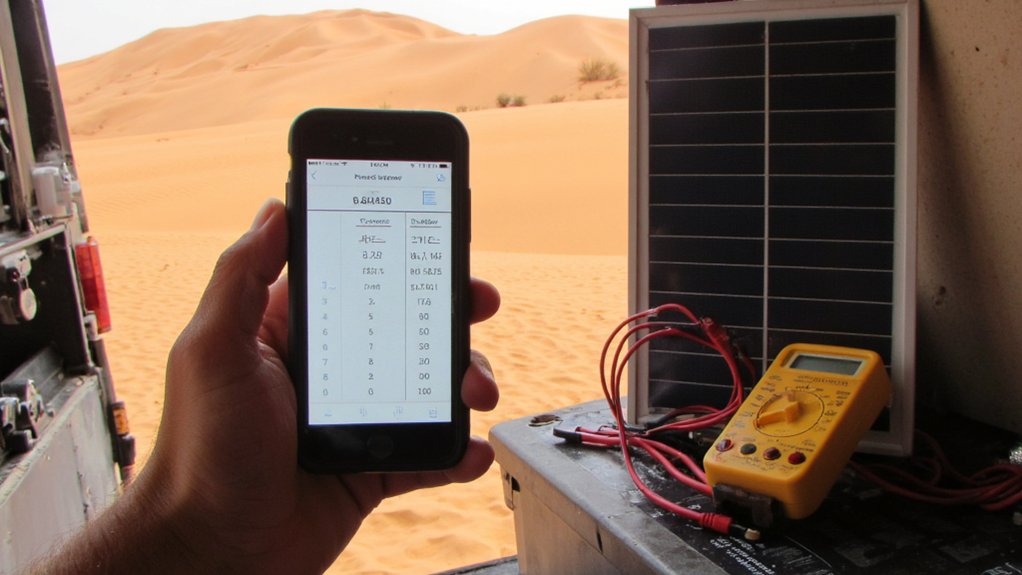
Battery capacity calculations that account only for depth of discharge miss real-world conditions that silently drain power.
I always add a 20-30% buffer to compensate for thermal drift and efficiency penalty.
Cold temperatures reduce lithium battery performance by 10-20%, while heat accelerates AGM degradation.
Parasitic loads from BMS systems, voltage monitors, and inverter standby modes continuously sip energy even when you’re not actively using devices.
This buffer guarantees I won’t find myself stranded with depleted batteries.
For a 100Ah usable capacity calculation, I multiply by 1.25, requiring 125Ah actual capacity to maintain reliable power throughout my overlanding adventures.
Calculate Final Battery Bank Size in Amp-Hours
How do you transform daily power consumption into a precise battery bank specification?
I divide my buffered daily consumption (in watt-hours) by my system voltage to get amp-hours needed per day.
Then I multiply by the number of days between charging opportunities.
Here’s the critical part: I account for battery chemistry limitations.
Lead-acid batteries shouldn’t discharge beyond 50%, so I double my result.
Lithium batteries allow 80-90% depth of discharge, requiring less capacity.
I also factor in efficiency metrics—inverter losses, charging efficiency, and temperature derating—to finalize my battery bank size.
Match Solar Panel Wattage to Your Daily Consumption
Solar panels must generate enough power to replenish what I consume daily, but raw wattage ratings don’t tell the whole story.
I account for real-world efficiency losses from panel orientation, temperature, and solar shading from trees or vehicle equipment.
I multiply my daily amp-hour consumption by 1.3 to compensate for these factors.
If I need 60Ah daily, I’d require 78Ah of solar generation.
Converting to watts, I divide by average sun hours in my location.
With five peak hours, that’s 15.6 amps at 12 volts, requiring roughly 187 watts of panel capacity for reliable recharging.
Refine Your Numbers After Real-World Testing
Theoretical calculations provide a starting point, but my actual power usage rarely matches spreadsheet predictions.
I recommend tracking consumption during your first few trips for proper field calibration.
Monitor which devices draw more power than expected and identify data anomalies in your original estimates.
I’ve found refrigerators often consume 20-30% more than manufacturers claim, especially in hot weather.
Note cloud coverage patterns that reduce solar charging efficiency.
After three outings, I adjust my battery capacity and panel wattage accordingly.
This iterative approach guarantees my system handles real-world demands rather than theoretical scenarios.
Conclusion
I’ve walked this process with dozens of overlanders, and the results speak for themselves. Take Sarah, who runs a rooftop tent fan, phone charger, and LED lights. She calculated 35Ah daily consumption, planned for three off-grid days, and added a 25% buffer. Her final setup: a 135Ah battery and 200W solar panel. She’s been exploring remote Utah for weeks without power anxiety. Now it’s your turn to crunch the numbers.